The United States is a Constitutional Federal Republic. 

Power is divided so no person or group can easily dominate, and ultimate authority rests with the people through elections and the 

Constitution.Separation of Powers
The Constitution splits the federal government into three co-equal branches with distinct jobs:


Legislative (Congress)

Makes laws and controls spending. It has two chambers—the House of Representatives (435 members based on population, 2-year terms) and the Senate (100 members, two per state, 6-year terms).

Executive (President)


Enforces laws, commands the military, conducts foreign policy, and nominates judges and agency heads. Includes the Vice President, Cabinet, and federal agencies.
Judicial (federal courts, headed by the Supreme Court)

Interprets laws and the Constitution, and decides cases. Justices have life tenure.

Checks and balances prevent any branch from becoming too powerful. Examples: the President can veto bills; Congress can override a veto with a two-thirds vote and must confirm many presidential appointments; courts can strike down laws as unconstitutional. Congress can also impeach and remove officials.


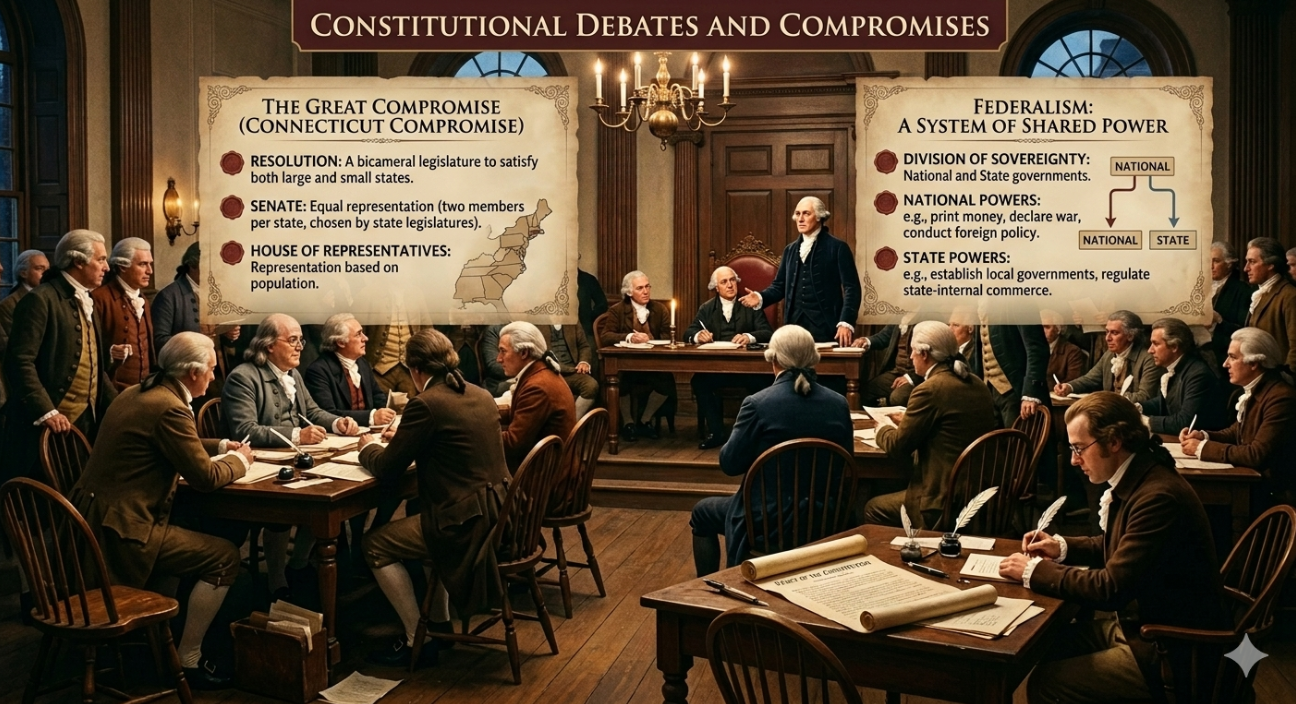
Federalism Power is shared between the national (federal) government and the states. The federal government has enumerated (listed) powers such as national defense, currency, interstate commerce, and treaties. Powers not given to the federal government are reserved to the states or the people (10th Amendment). States handle most education, policing, elections administration, and family law. Local governments (cities, counties) get their authority from the states. This creates many layers of government rather than one centralized system. 
2021-2025.state.gov
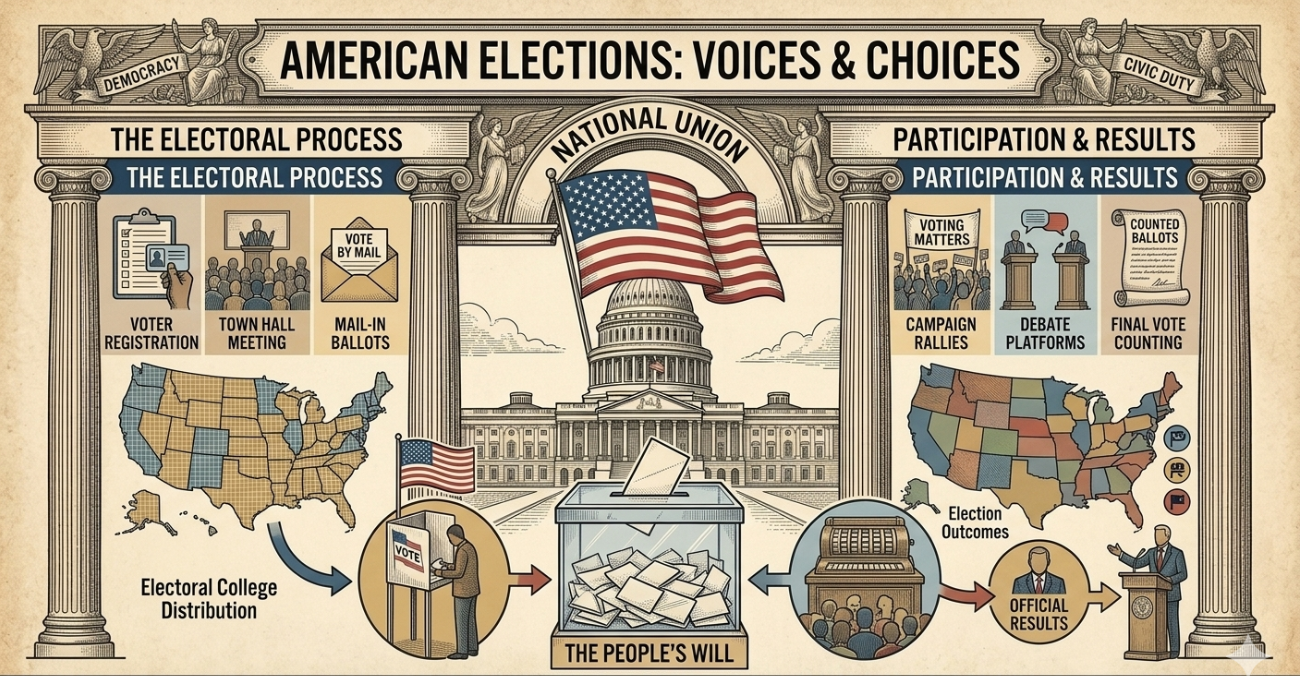
Elections Most major offices are filled by popular vote, but the system is deliberately staggered and decentralized. States run elections under rules that must follow the Constitution (e.g., no poll taxes, voting age 18).
President: Every four years. Voters choose electors in each state; the Electoral College then formally elects the President. A candidate needs a majority of electors (270 of 538).
Congress: House every two years; Senate staggered so about one-third of seats are up every two years.
State and local: Governors, state legislators, mayors, and many other offices on their own cycles.
Primaries or caucuses usually choose party nominees before the general election. Voting is a right of citizens; states set most registration and ballot rules.
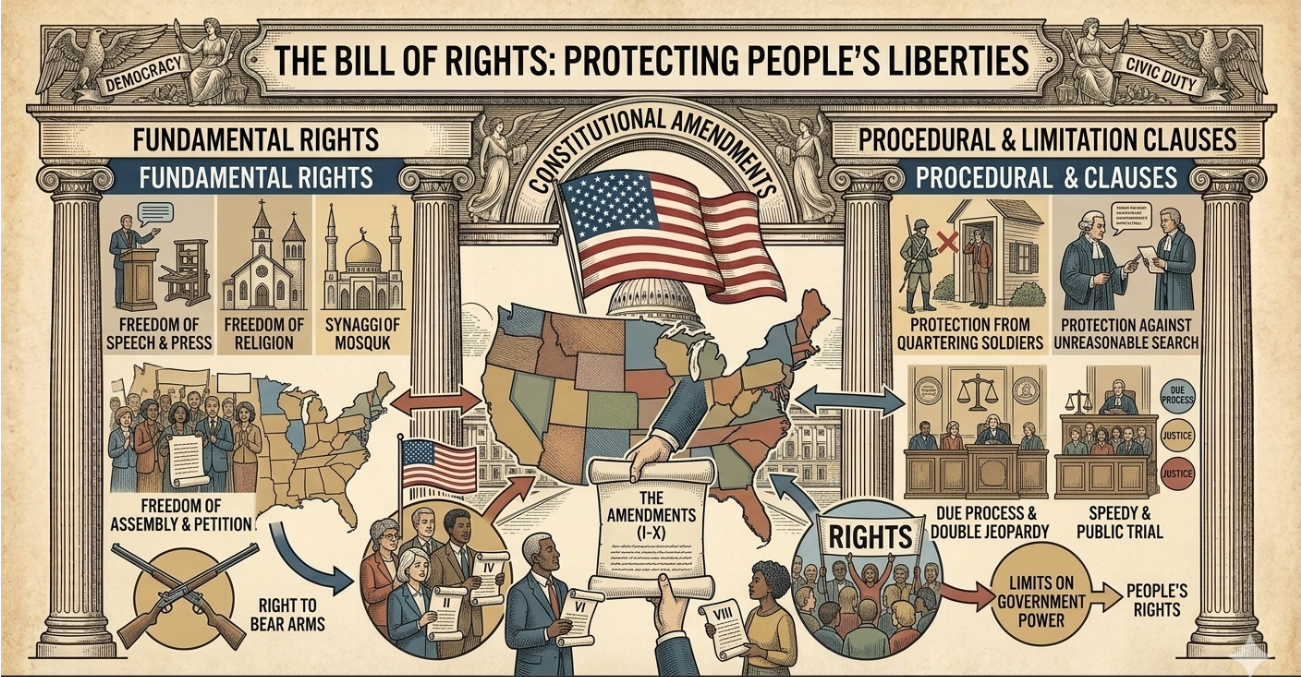
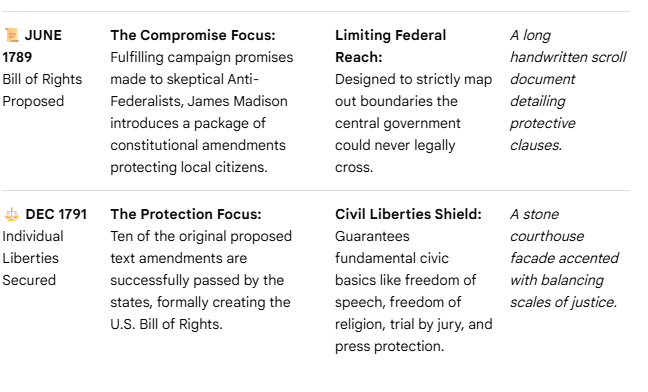
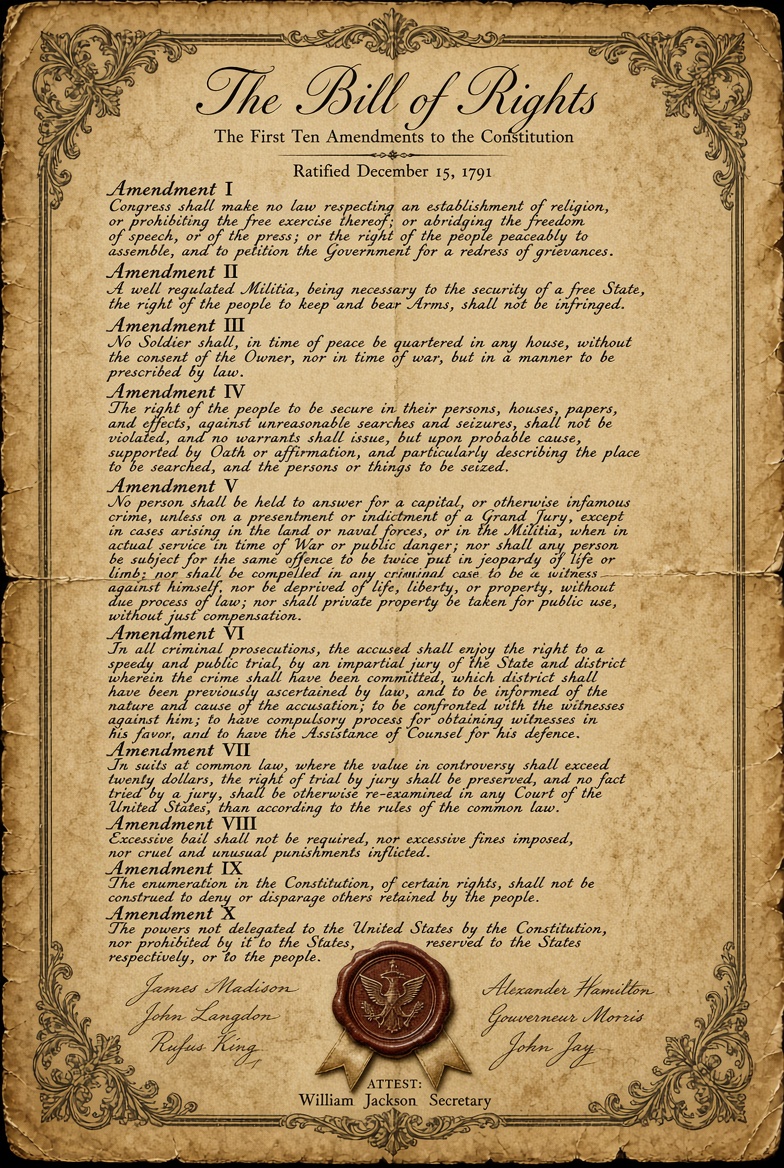
Citizens’ Rights The first ten amendments (Bill of Rights) plus later amendments protect individuals from government overreach. Core protections include:
Freedom of speech, press, religion, assembly, and petition (1st Amendment).
Right to keep and bear arms (2nd).
Protection against unreasonable searches and seizures (4th).
Due process, protection against self-incrimination, and just compensation for taken property (5th).
Right to a speedy public trial and counsel (6th).
Voting rights expanded by later amendments (no racial barriers, women’s suffrage, 18-year-old vote).
Many of these protections apply to everyone in the country, not only citizens. Rights that belong specifically to citizens include voting in federal elections and running for most federal offices.
nps.gov
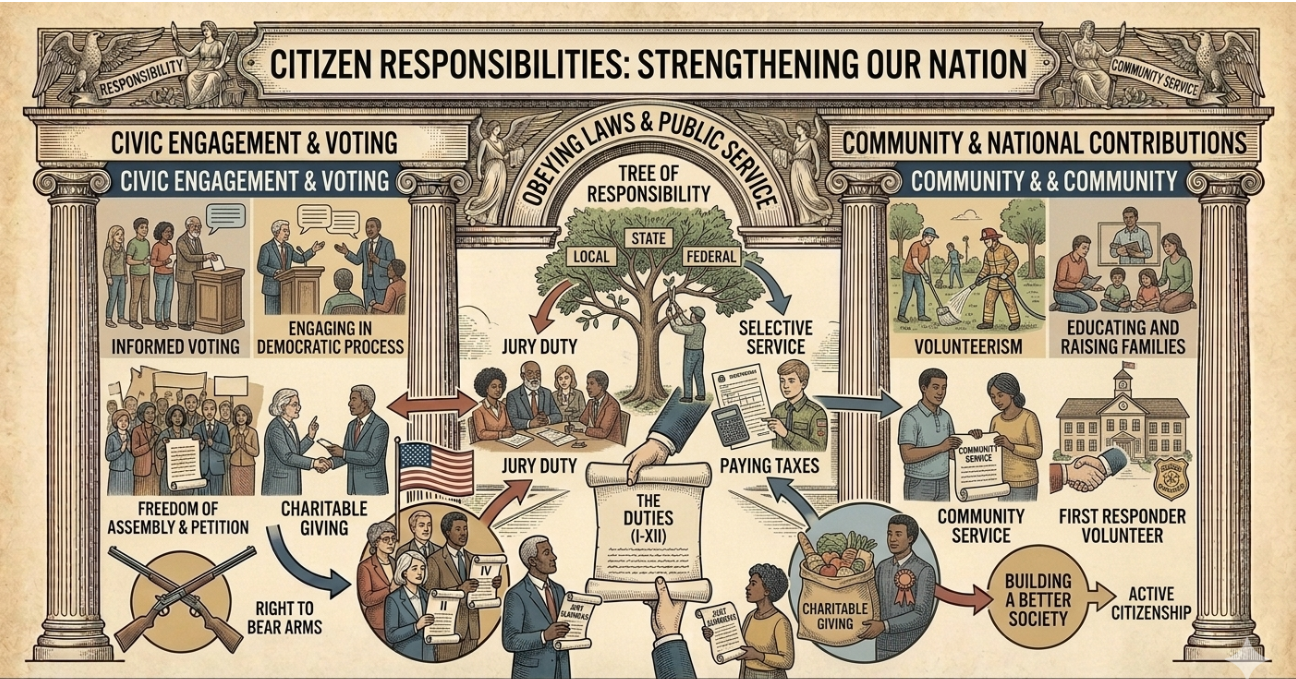
Citizens’ Responsibilities A republic works only if people participate. Legal duties include obeying laws, paying taxes, serving on juries when called, and (for men 18–25) registering with Selective Service. Strong civic responsibilities include staying informed, voting, serving in the military or civic roles if called, and speaking up to officials. Naturalized citizens also take an oath to support the Constitution and defend the country.


civics.asu.edu
The United States Constitution serves as the supreme law of the land, establishing the structural framework, core principles, and legal boundaries of the American government. Written in 1787 during the Constitutional Convention, the Founding Fathers drafted this historic document to replace the weak Articles of Confederation, which had left the newly independent nation with a fragile central government unable to manage national debt, settle interstate disputes, or enforce national security. By designing a system anchored by the separation of powers, checks and balances, and federalism, the Framers aimed to strike a delicate stability: creating a federal government strong enough to unite and protect the states, yet strictly limited enough to prevent tyranny and safeguard individual liberties.
The Constitutional Convention was a historic meeting held in Philadelphia, Pennsylvania, from May 25 to September 17, 1787, where delegates from 12 of the original 13 states gathered to design a new system of governance for the United States.
Originally, the 55 delegates—including prominent figures like George Washington, James Madison, Benjamin Franklin, and Alexander Hamilton—met with the sole intention of revising the weak Articles of Confederation. However, they quickly realized that patching up the old system would not suffice. Instead, they decided to completely scrape it and secretly draft an entirely new document from scratch, which ultimately became the United States Constitution.
The convention was marked by intense debates and major compromises between opposing political factions:
The Great Compromise (Representation): Large states wanted congressional representation based on population size (the Virginia Plan), while small states wanted equal representation for every state (the New Jersey Plan). The delegates compromised by creating a bicameral legislature: the House of Representatives (based on population) and the Senate (two members per state).
The Three-Fifths Compromise: Southern and Northern states fiercely debated how enslaved people should be counted for taxation and congressional representation. They eventually agreed to count three-fifths of the enslaved population for both purposes.
Federal Power vs. States' Rights: Delegates argued over how much authority to give the central government. They settled on a balanced model of federalism, leaving specific reserved powers to the states while giving the national government the power to levy taxes, regulate commerce, and maintain a military.

James Madison earned the title of the "Father of the Constitution" due to his pivotal role in planning, drafting, debating, and ratifying the document. Rather than just participating, Madison was the intellectual architect who arrived in Philadelphia with a comprehensive blueprint for a new national government.
His foundational contributions include:
The Virginia Plan: Madison authored this revolutionary proposal, which shifted the convention's focus from merely fixing the weak Articles of Confederation to creating an entirely new federal structure with three separate branches: Legislative, Executive, and Judicial.
Meticulous Notes: Madison kept a detailed personal journal of every daily debate, speech, and compromise throughout the secret summer convention. His notes serve as the primary historical record of how the Constitution was built.
The Federalist Papers: Alongside Alexander Hamilton and John Jay, Madison co-authored these highly influential essay campaigns (writing under the pseudonym "Publius") to successfully convince voters to ratify the new Constitution.
The Bill of Rights: To appease critics who feared federal overreach, Madison drafted the first ten amendments to protect individual liberties, ensuring the Constitution's survival and widespread acceptance.

The Federalist Papers are a collection of 85 political essays written between October 1787 and May 1788 to persuade the public—specifically the voters of New York—to ratify the newly drafted United States Constitution.
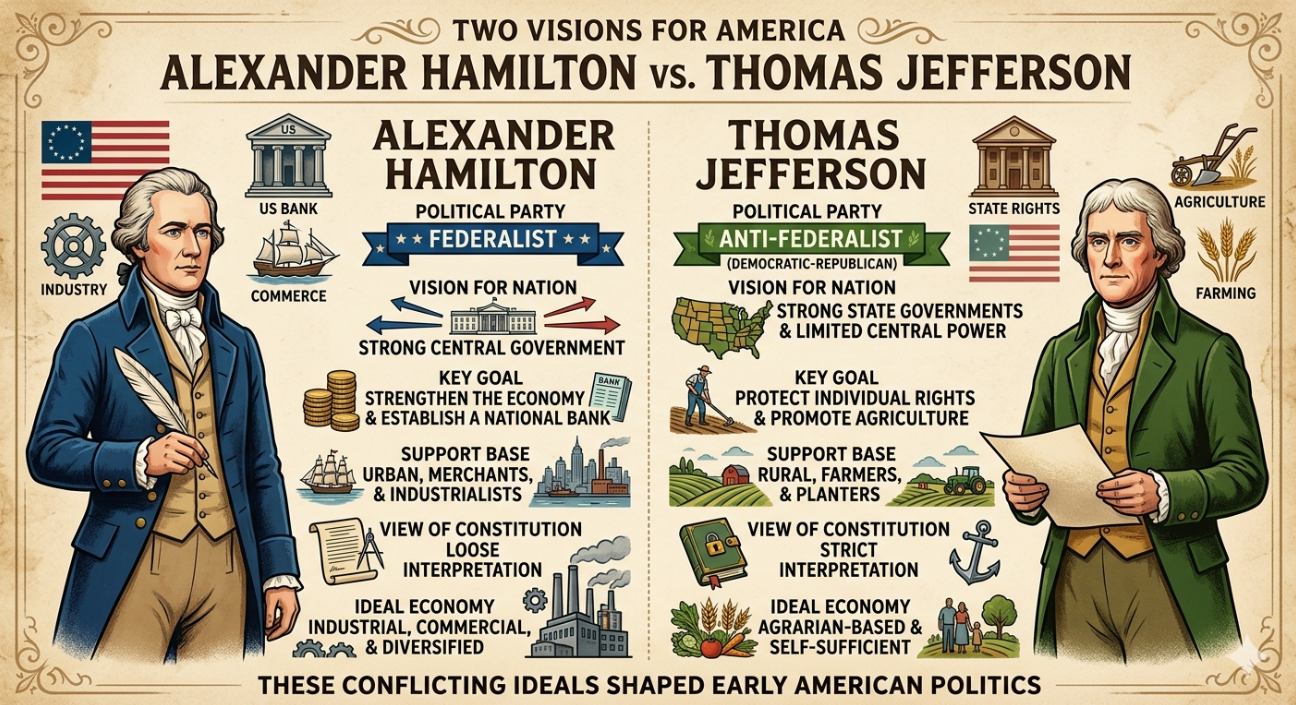
At the time, the nation was fiercely divided over whether to accept the Constitution, with critics (known as Anti-Federalists) arguing that a strong central government would destroy individual liberties and mimic British tyranny. To counter these fears, three prominent Founding Fathers secretly authored the essays under the shared pen name "Publius" (honoring a foundational founder of the ancient Roman Republic):
Alexander Hamilton: Wrote the vast majority of the essays (51), focusing heavily on the executive branch, the judiciary, and military power.
James Madison: Wrote 29 essays, providing the core philosophical foundation regarding representation, factions, and the system of checks and balances.
John Jay: Wrote 5 essays, primarily focusing on foreign policy and international relations before falling ill.


Why They Matter Today

The Federalist Papers are widely considered some of the most important pieces of American political philosophy ever written. Because they explain the exact logic, intent, and meaning behind every article of the Constitution, the U.S. Supreme Court still frequently cites them today when making landmark legal rulings to determine what the Framers originally intended.

The Two Most Famous Essays Federalist No. 10 (by Madison): Argues that a large republic is the best defense against "factions" (political parties or special interest groups) because the diversity of a large country prevents any single group from gaining absolute control.
Federalist No. 51 (by Madison): Explains the necessity of the internal structure of government, famously stating: "If men were angels, no government would be necessary." It lays out how dividing power between three separate branches ensures that "ambition must be made to counteract ambition."